


Two identical offices. Fifty people each. Same desks, same printers, same carpet that smells faintly of 2019. One has a plant wall. The other has a Blueair Blue 3210 in the corner, running at 14 watts.
Here is the uncomfortable part: the plant wall is doing almost nothing to the air. The purifier is doing the job. And the reason everyone believes otherwise is a 1989 NASA report that was never wrong — it was just never finished.
The NASA Clean Air Study: what it actually said
In 1989, NASA and the Associated Landscape Contractors of America tested 10 plant species in sealed chambers, injecting benzene, formaldehyde and trichloroethylene and watching concentrations fall. The plants did remove the chemicals. That part is real.
What the report also said, in the same document, is that the most promising technology for sealed environments was “activated carbon filters containing fans,” which “have the capacity for rapidly filtering large volumes of polluted air.” NASA’s own conclusion: plants plus carbon plus fans. Not plants alone.
The follow-up math is the part that got lost. To match the VOC removal rate of ordinary outdoor-to-indoor air exchange in a typical building (about one air change per hour), you need 10 to 1,000 plants per square metre of floor space. For a 50 m² office, that is 500 to 50,000 plants. The EPA’s position, after decades of follow-up work, is blunter: “There is currently no evidence that a reasonable number of houseplants remove significant quantities of pollutants in homes and offices.”
The real ranking: plant CADR vs a purifier
The cleanest comparison exists because Drexel University’s Cummings and Waring (2020) took 12 published chamber studies, 196 experimental results, and converted every one of them into the same unit air purifiers use: Clean Air Delivery Rate, in m³/h.
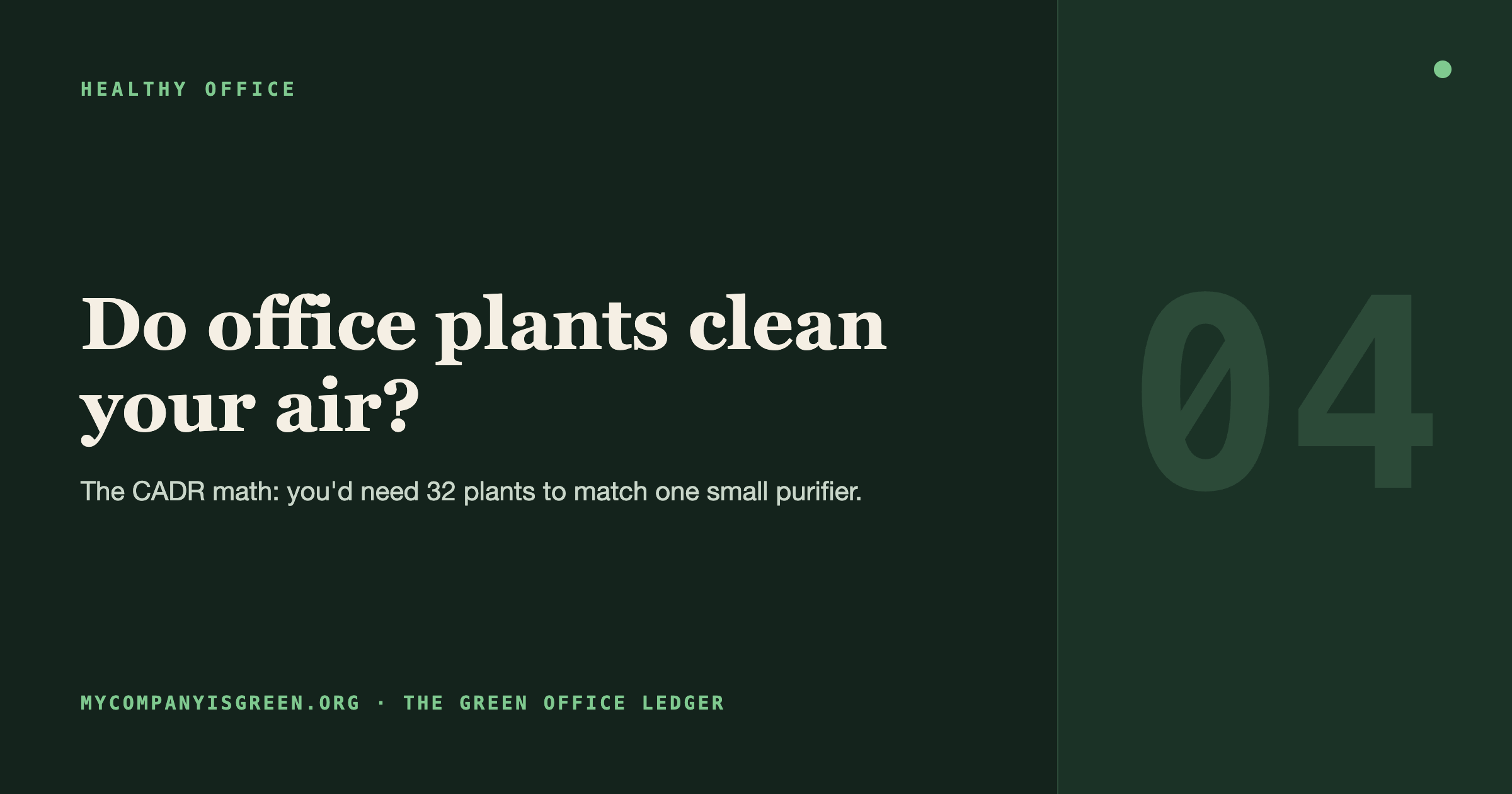
The median single-plant CADR across all 196 results: 0.023 m³/h.
A mid-size office purifier, the Blueair Blue 3210, delivers 210 m³/h. Divide, and you get the number that should end the argument: roughly 9,100 plants to match one purifier. A Dyson Purifier Cool TP07 at 290 m³/h needs about 12,600.
Per species, the chamber data (300-litre test chambers, single plants, specific VOCs) looks like this:
| Plant | Species | VOCs addressed | Realistic removal rate | Source |
|---|---|---|---|---|
| Pothos | Epipremnum aureum | Formaldehyde, toluene, xylene, benzene, acetone, TCE | 7–41 chamber volumes/h | Oyabu et al. 2003, via Dela-Cruz 2014 |
| Peace lily | Spathiphyllum | Formaldehyde, toluene, xylene, benzene | 8–42 chamber volumes/h | Porter 1994, via Dela-Cruz 2014 |
| Snake plant | Dracaena trifasciata | Formaldehyde, benzene | 10–35 chamber volumes/h | Oyabu et al. 2003, via Dela-Cruz 2014 |
| Rubber plant | Ficus elastica | Formaldehyde | 10–35 chamber volumes/h | Oyabu et al. 2003, via Dela-Cruz 2014 |
| Areca palm | Dypsis lutescens | Benzene, formaldehyde, TCE | NASA 1989 test species; chamber rates | Wolverton 1989 |
| Spider plant | Chlorophytum comosum | Formaldehyde, xylene | Chamber-tested; low single-digit V/h | Dela-Cruz 2014 review |
Read the table the way an accountant should. “41 chamber volumes/h” in a 300-litre chamber means the plant is clearing a volume of air equal to 12 litres per hour of that one chemical. A purifier moves 210,000 litres per hour through a filter. The pothos is not a slow purifier. It is a very small purifier with a leaf budget.
The ranking by breadth of VOCs addressed: pothos and peace lily lead (five to six compounds), snake plant and rubber plant follow (two each), areca palm and spider plant round out the list. By rate, the spread is wide — the same species can vary tenfold between studies — which is exactly why the Drexel team’s median, not any single species’ best result, is the honest number to budget against.
What plants genuinely do for offices
The air is not where the money is. The money is in the people.
- Productivity. Nieuwenhuis et al. (2014) ran three field experiments in real UK and Dutch offices. Enriching a “lean” office with plants increased measured task productivity by 15%, with no rise in errors. The Dutch call-centre arm found no significant productivity difference — which is why I cite the 15% with its caveat, not as a law of physics.
- Symptoms. A 1995–96 Norwegian crossover study (60 office workers, plants in, plants out, conditions reversed) found neuropsychological symptoms down 23%, fatigue down 30%, cough down 37% when plants were present.
- Mood. University of Technology Sydney work found office plants associated with tension and anxiety down 37%, depression down 58%, anger down 44%.
- Perception. A 2019–2020 field study across nine Dutch organisations found fewer complaints about dry air, higher workspace satisfaction, and fewer health-related complaints at work.
What plants do not do, at realistic densities: remove CO₂ at a rate that matters (a person exhales roughly 1 kg of CO₂ a day; a desk plant absorbs a few grams), or cut VOCs below the level your ventilation already achieves. If your office has a VOC problem, the fix is source control and air changes — or a machine with a fan.
What you save
| Option | Upfront | Ongoing | What you actually get |
|---|---|---|---|
| Plant wall, 50 m² office at 10 plants/m² (500 plants, ~€12 each) | ~€6,000 | Watering, replacement, light | 15% productivity in the best field data; 23–30% symptom reduction; a room people like |
| One HEPA purifier (Blueair 3210, ~€350) | ~€350 | ~€6/year electricity (14 W, 8 h/day, 250 days, €0.20/kWh) | 210 m³/h of real CADR; ~9,100 plants’ worth of VOC removal |
| Both, honestly | ~€6,350 | ~€6/year + watering | The purifier does the air; the plants do the people. Payback on the purifier is immediate; the plants pay back in retention and focus, not in filter math |
The honest framing: you are not buying plants for the air. You are buying air for the purifier and people for the plants. Budget them as separate line items and stop letting the pothos take credit for the fan.
Methodology
Plant removal rates: chamber studies compiled in Dela-Cruz (2014), Environmental Science and Pollution Research, which reviews 100+ species; rates are per-plant, per-VOC, in sealed 300-litre chambers and are not directly comparable to purifier CADR. Single-plant CADR median (0.023 m³/h) and the 10–1,000 plants/m² figure: Cummings & Waring (2020), Journal of Exposure Science & Environmental Epidemiology 30:253–261, which converted 196 results from 12 studies into CADR. Purifier CADR: manufacturer specifications (Blueair Blue 3210: 210 m³/h; Dyson Purifier Cool TP07: 290 m³/h). Productivity and wellbeing: Nieuwenhuis et al. (2014), Journal of Experimental Psychology: Applied 20(3):199–214; Fjeld et al. (1998), Indoor Built Environment 7:204–209; University of Technology Sydney field data; Dutch multi-organisation field study (2019–2020), Frontiers in Psychology.
Sources
- NASA/ALCA Clean Air Study final report, B.C. Wolverton, 1989: https://ntrs.nasa.gov/citations/19930073077
- Cummings, B.E., Waring, M.S. “Potted plants do not improve indoor air quality: a review and analysis of reported VOC removal efficiencies.” J Expo Sci Environ Epidemiol 30, 253–261 (2020), published 6 Nov 2019: https://www.nature.com/articles/s41370-019-0175-9
- Dela-Cruz, R.A. “Can ornamental potted plants remove volatile organic compounds from indoor air? A review.” Environ Sci Pollut Res (2014): https://greenplantsforgreenbuildings.org/wp-content/uploads/2014/09/Dela-Cruz-2014-review-on-phytoremediation-with-indoor-plants-2.pdf
- Nieuwenhuis, M., Knight, C., Postmes, T., Haslam, S.A. “The relative benefits of green versus lean office space: Three field experiments.” J Exp Psychol Applied 20(3), 199–214 (2014): https://doi.org/10.1037/xap0000024
- Fjeld, T., Veiersted, K.B., Sandvik, L., Riise, G., Levy, F. “The effect of indoor foliage plants on health and discomfort symptoms among office workers.” Indoor Built Environ 7:204–209 (1998)
- Iowa State Extension, “Improving Indoor Air Quality with Houseplants” (EPA position cited): https://yardandgarden.extension.iastate.edu/how-to/improving-indoor-air-quality-houseplants
- Blueair Blue 3210 specifications (CADR 210 m³/h): https://blueair.com
- Dyson Purifier Cool TP07 specifications (CADR 290 m³/h): https://www.dyson.com
Next leak to fix
Carla Lavigne is Green Ops Editor at mycompanyisgreen.org and the colleague who brings the calculator to the audit.
More from the ledger
The 5 printer settings that cut printing costs 40% (and how to enforce them)
Duplex, grayscale, draft mode: EPA, HP and DLA figures behind a 40% cut in print costs — and the GPO settings IT admins use to make the savings stick.

Paper prices, 10 years: what your office actually pays now
Office paper is up 42% since 2016. What drives the price, when it eases off, and the three levers that cut your bill before the market does.
The most energy-efficient office computers of 2026, ranked by real cost
A mini-PC runs on 9–18 kWh a year; some tower PCs burn 4× more for the same spreadsheets. The 2026 efficiency ranking, with euro figures per machine.